
A solution from photography applied to lighting
Shuttle
In the late 1980s, lighting designers had many light sources to choose from, but these were rarely available within a coordinated product family. There were incandescent lamps, 220 V halogen lamps, 12 V halogen lamps with transformers, and fluorescent and metal halide lamps with separate, bulky ballasts. Each light source required its own reflector, housing and power supply. Shops and museums therefore often ended up using fittings with very different appearances.
- Company
- iGuzzini illuminazione
- Product
- Shuttle, family of track projectors
- Year
- 1987
- Design
- Bruno Gecchelin
- Status
- Discontinued
- Recognition
- ADI Compasso d’Oro 1989
The project
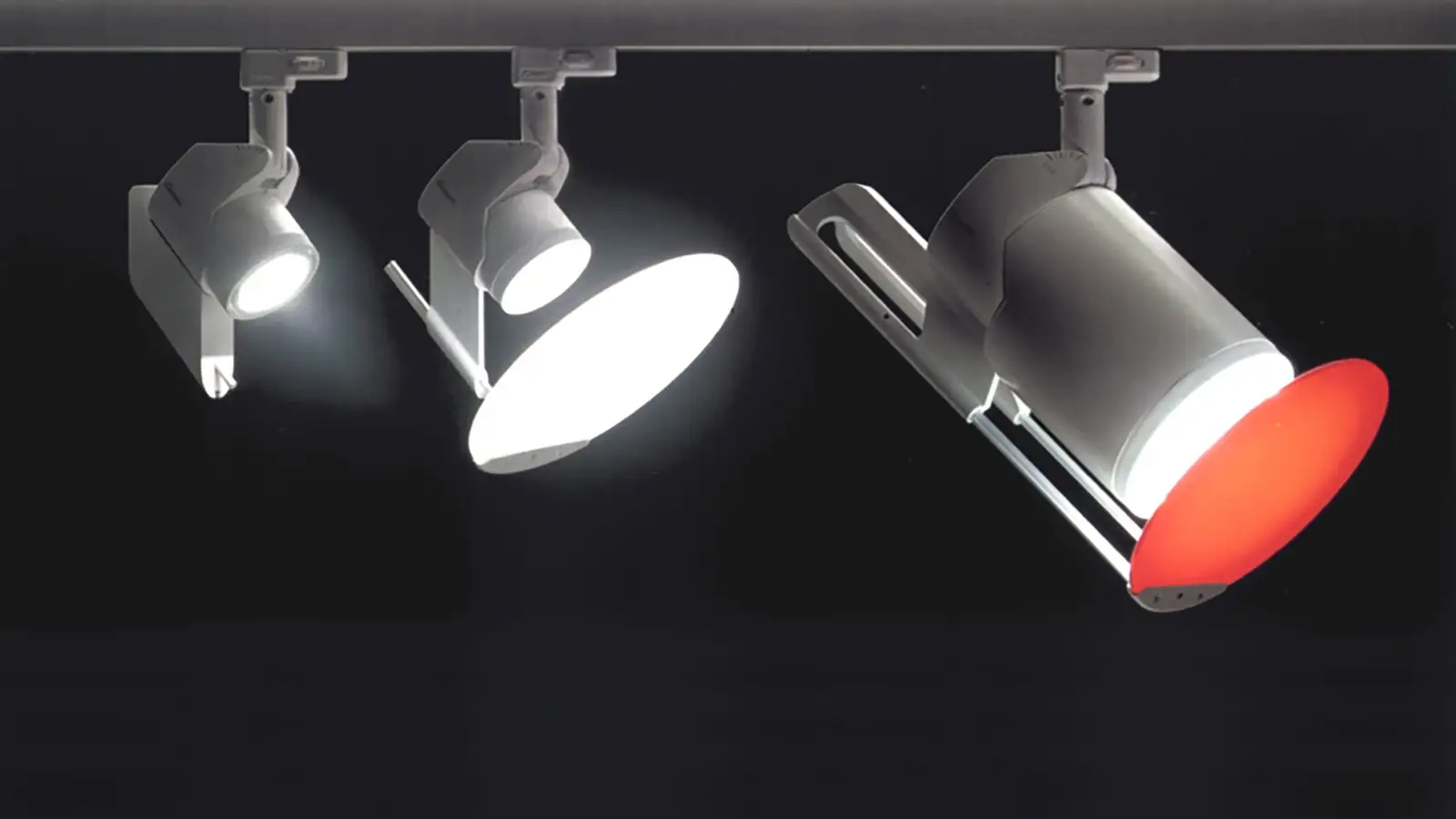
The company asked to cover the whole range with coordinated products. Everyone knew it would not be easy: it was a wish, and nobody knew whether it could be done. In those years German competitors had sidestepped the problem with a catalogue of unrelated luminaires, each designed for its own source.
Both obvious approaches led to a dead end. Designing each spotlight separately would have recreated the fragmented range the company wanted to move beyond. Scaling the same housing to suit every wattage would have produced awkward proportions at the larger sizes and unnecessary bulk at the smaller ones. Light sources do not scale proportionally: the space required by a 12 V halogen lamp is not simply a smaller version of that needed by an HQI source.
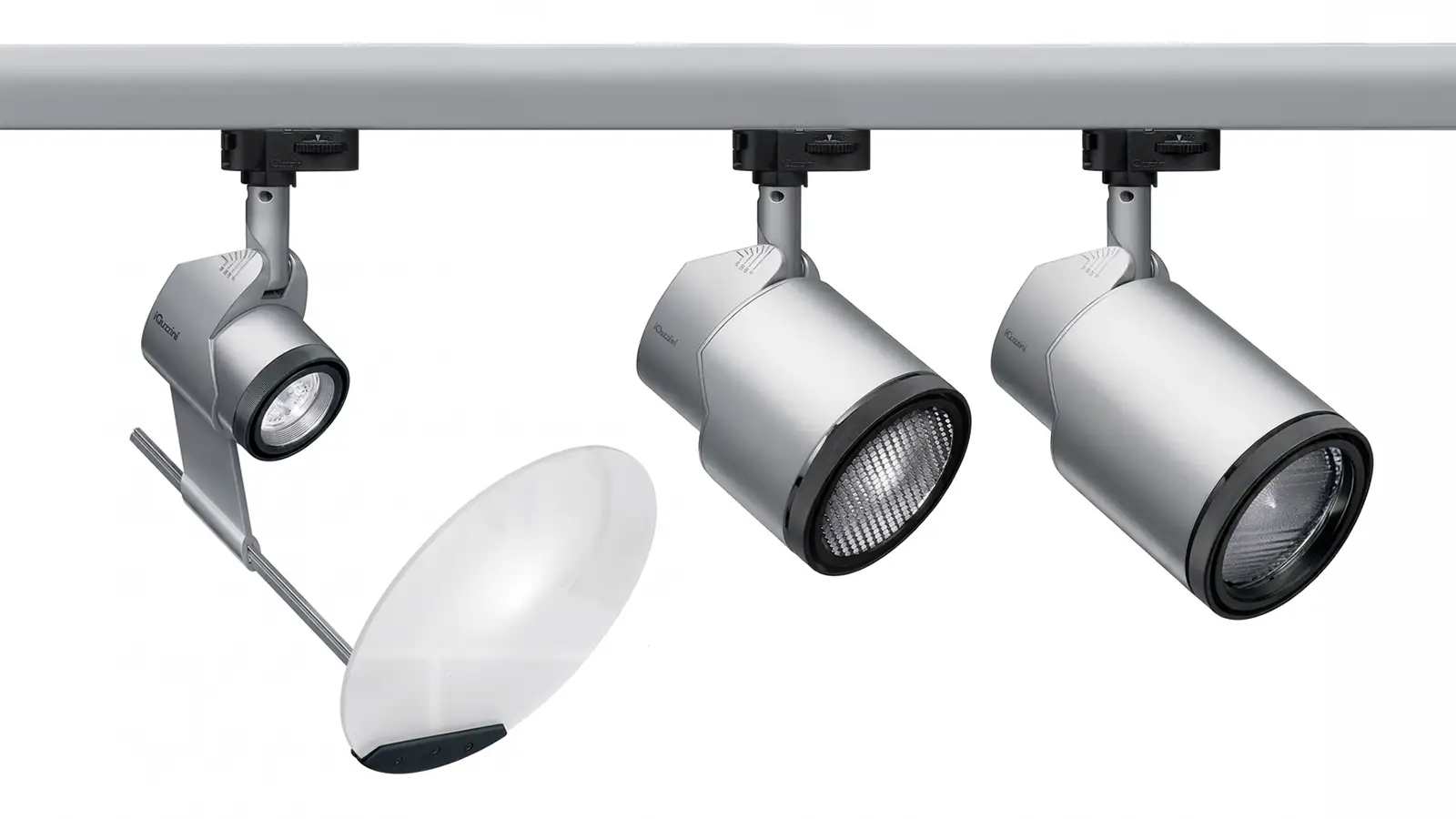
The solution came not from lighting, but from photography.
Bruno Gecchelin had been shooting on film for years and owned several camera bodies and lenses. In that field the problem had been solved for decades, so obviously that it no longer looked like a solution: the body stays the same, the lens changes. A telephoto, a macro or a wide-angle lens fit the same body, and nobody has ever thought that a camera with a telephoto lens is a different product.
Applied to spotlights, the principle is simple: the body houses the elements that do not depend on the light source, while an attached optical assembly contains those that do — the lamp and its reflector. The body remains unchanged; only the assembly fitted to the front varies. A single body could therefore support fifteen or twenty types of luminaire.
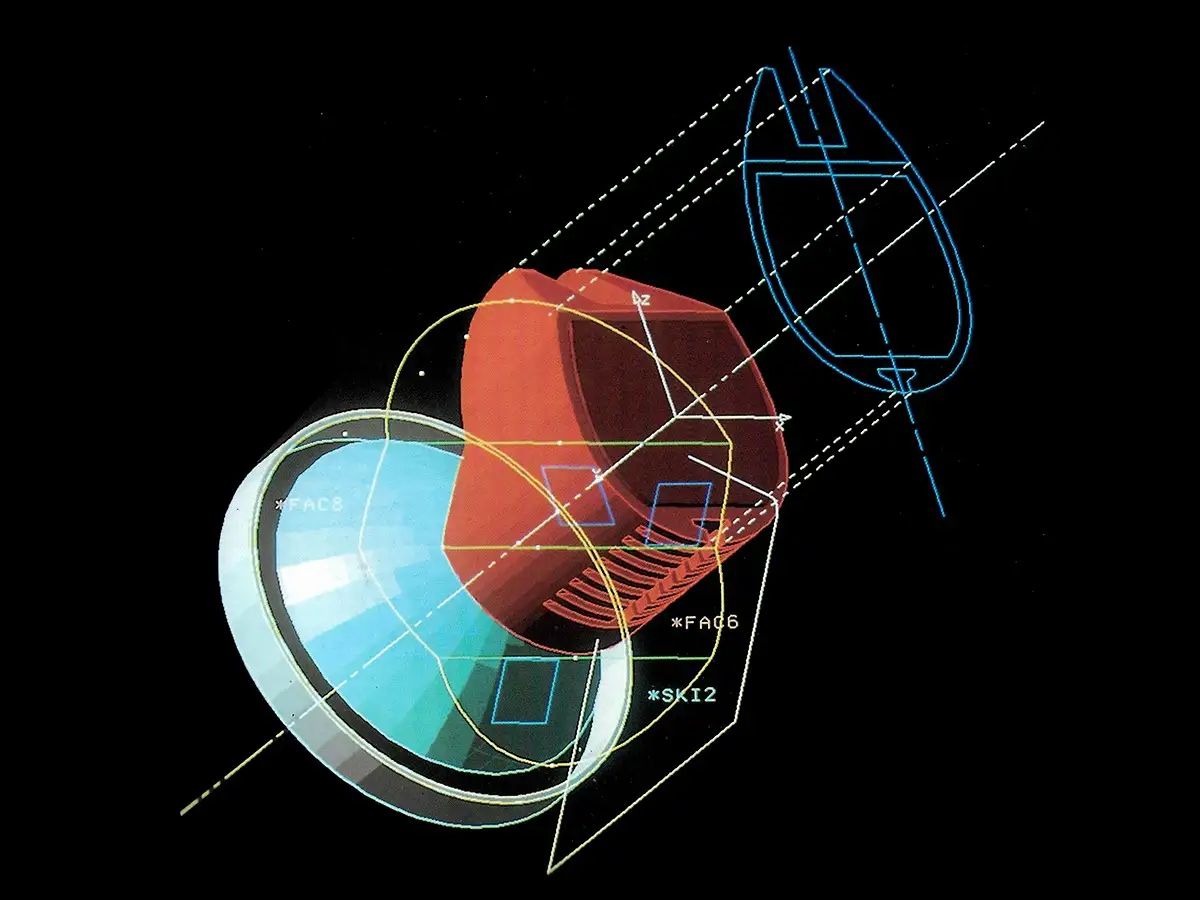
The second common element is the track adaptor, shared across the family. The track layout is often installed before the luminaires are selected, so fittings must be interchangeable to achieve the required wattage and beam angle without altering the installation.
The third element is the accessory system: lenses, filters, louvres, barn doors and framing attachments. These address the different requirements of shops and museums without creating separate product variants. They fit in front of the optics on the same luminaire bodies already installed.
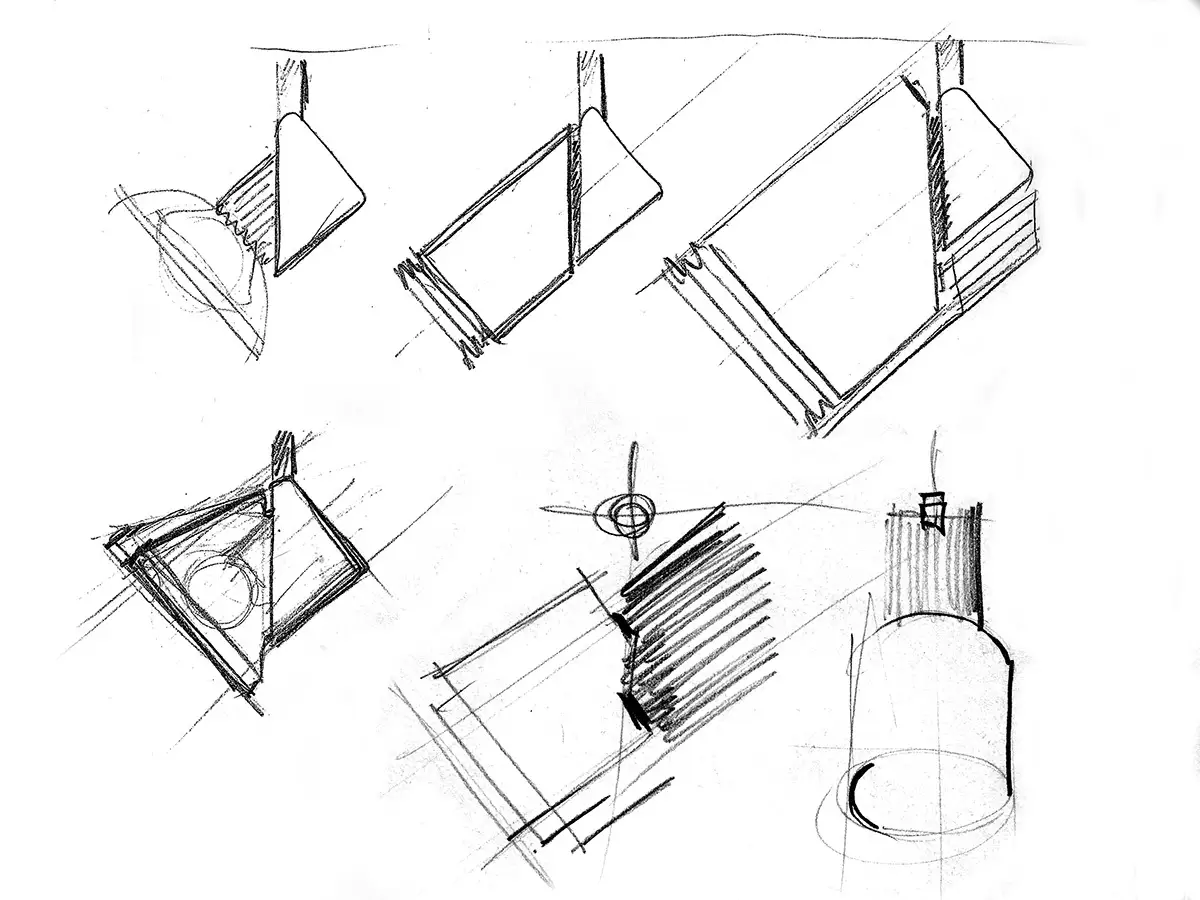
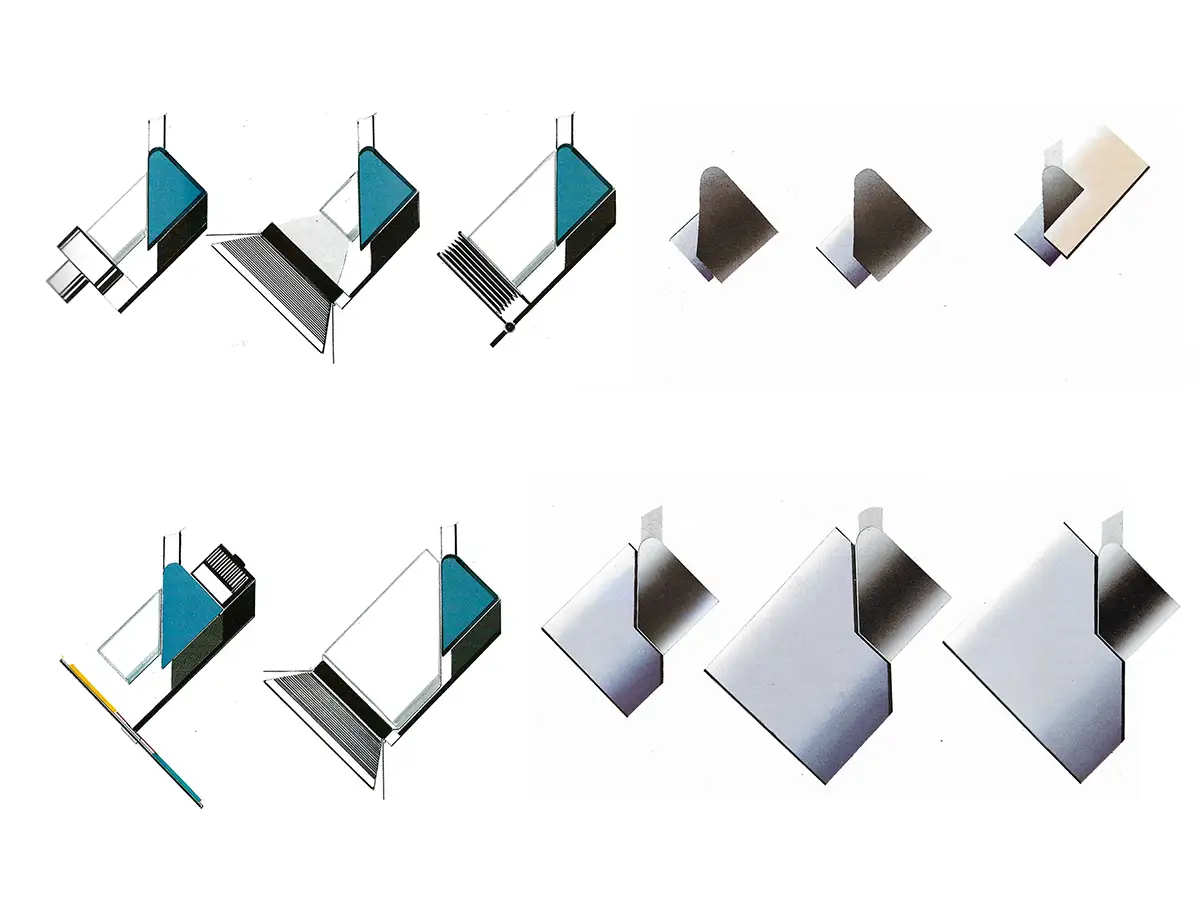
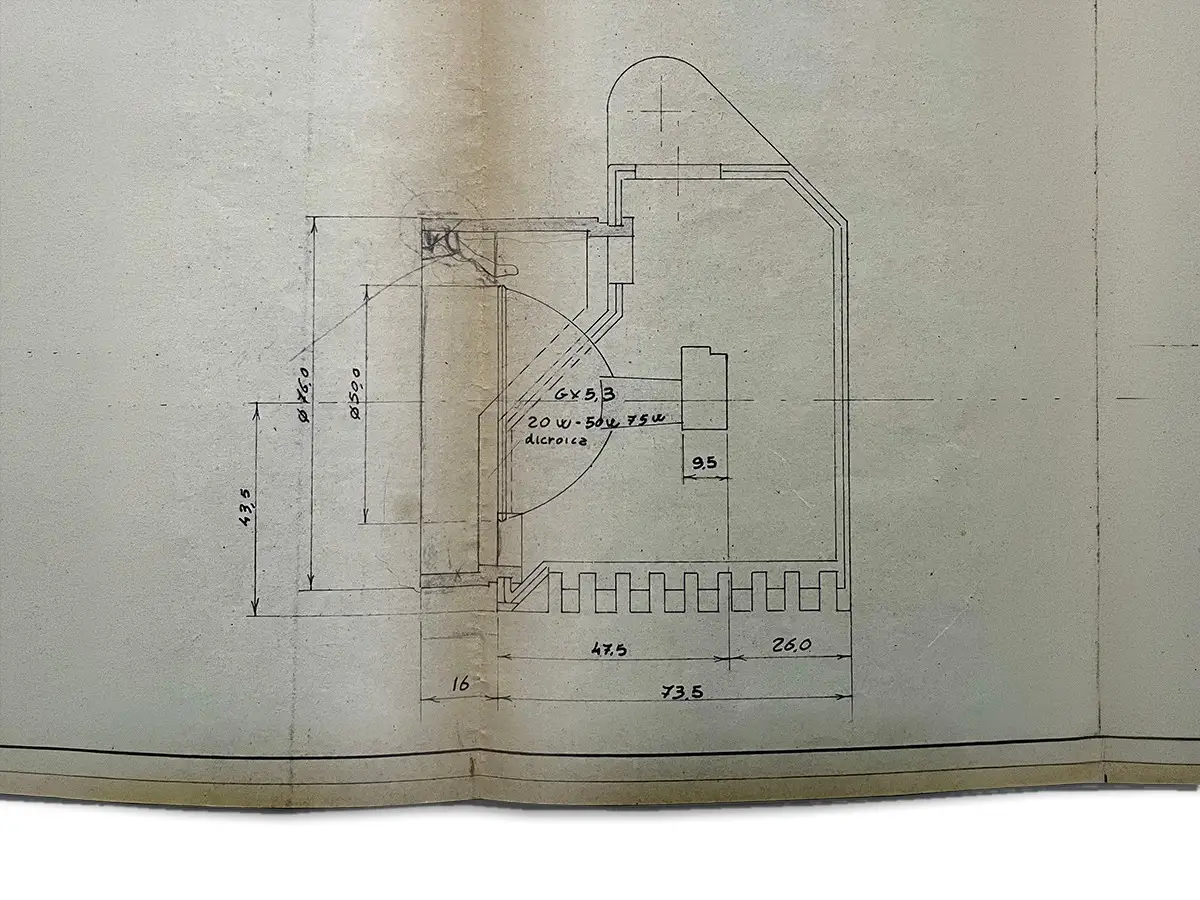
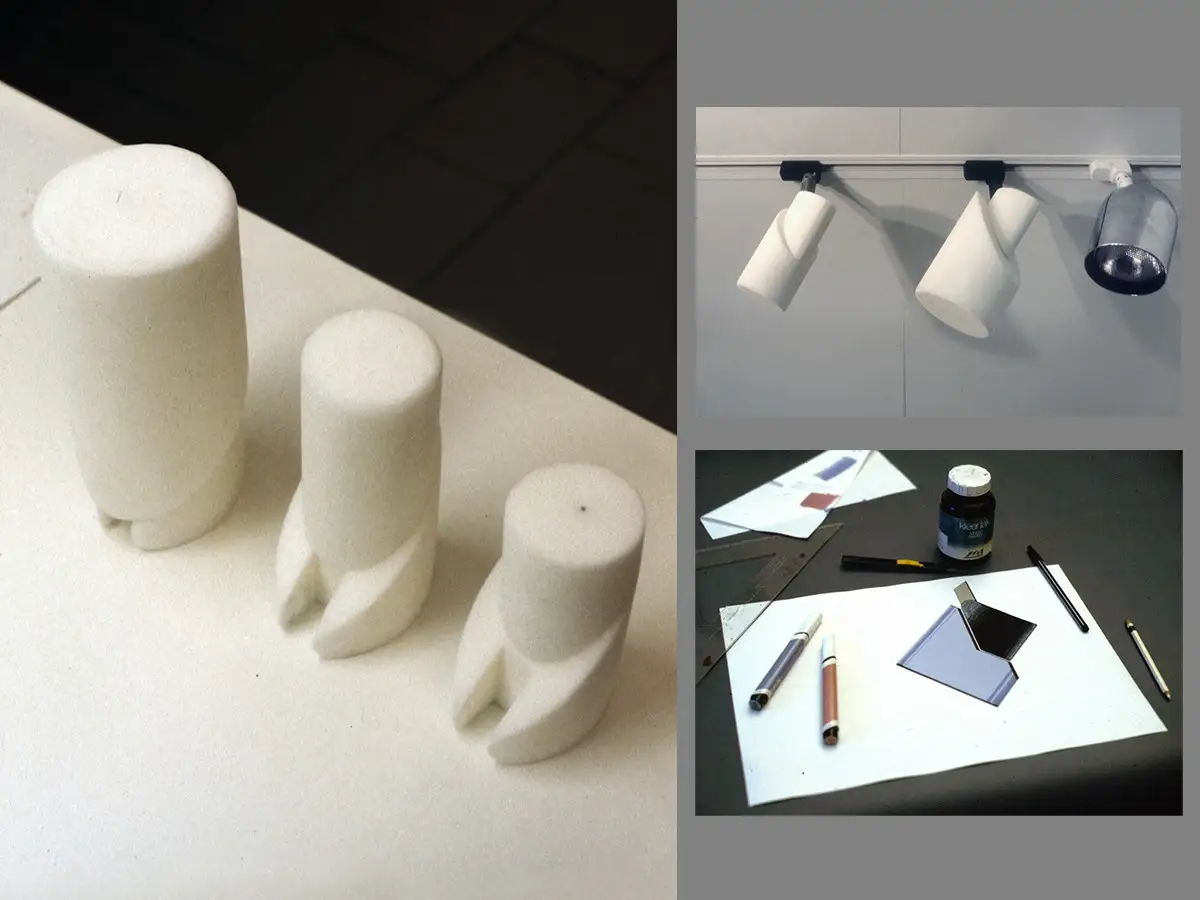
Designing such a complex programme of objects, which grew richer over the years, at first called for an approach based on testing and fine-tuning. Only foam models and study prototypes made it possible to bring out its critical points.
The arrival of the first CAD systems made it easier to refine the design, but the idea itself emerged and developed through iterative testing with three-dimensional mock-ups. These clarified how the system worked as a whole and revealed any inconsistencies. The varying sizes and forms of the components could easily have led the design astray; physical models made it possible to keep them under control.
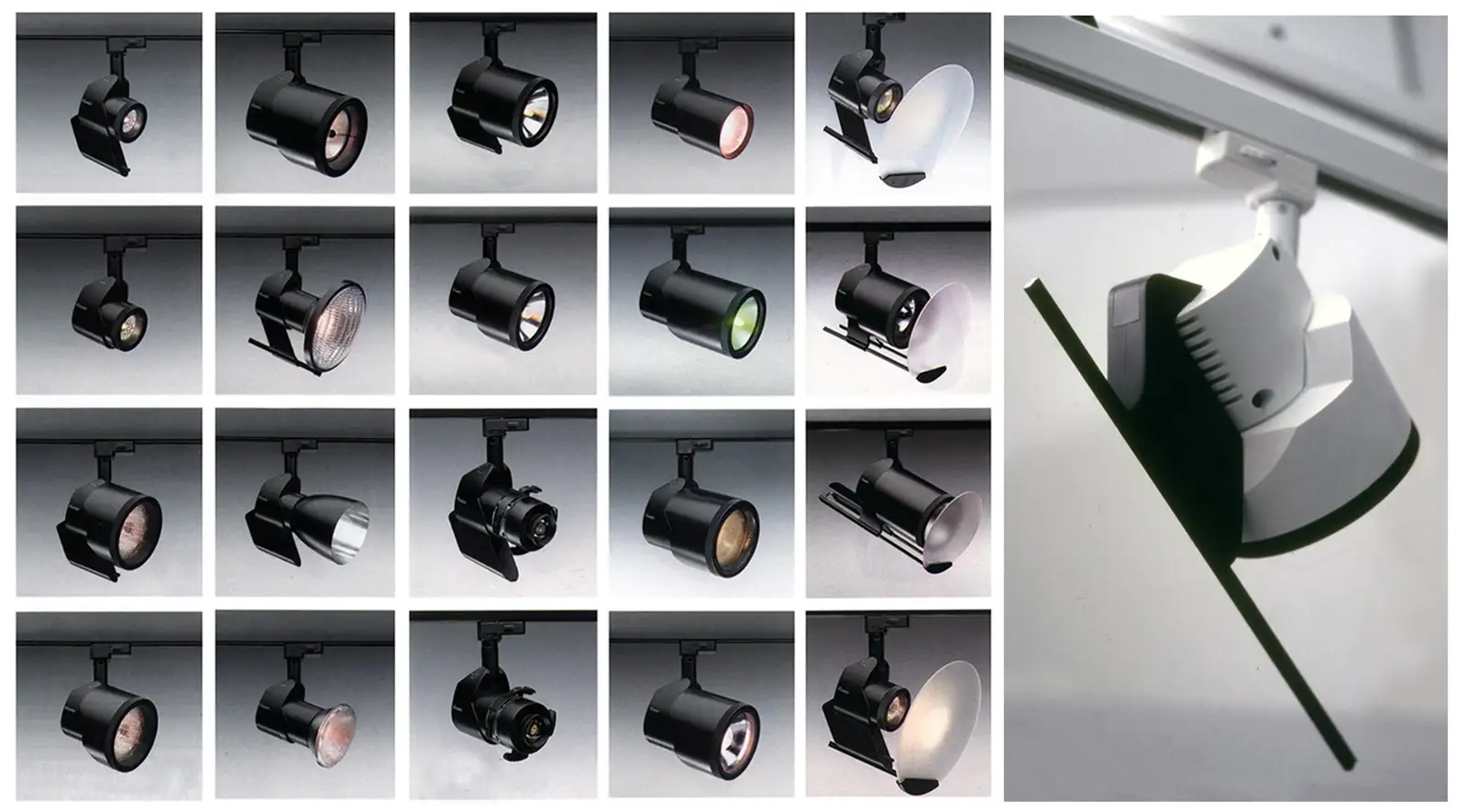
In 1981 Virgola had taken iGuzzini from decorative lamps to the technical market. Shuttle, six years and three products later — Trio in 1983, Prisma in 1984, Mago HQI in 1985 — is the project in which that market is occupied with a complete system rather than with single luminaires. The catalogue kept growing in the following years, taking in new sources and solutions without the rule having to be revised. The collaboration between the studio and the company went on for more than twenty years, with the Parallel spotlights and the Light Air linear fluorescent systems among the products that came out of it.
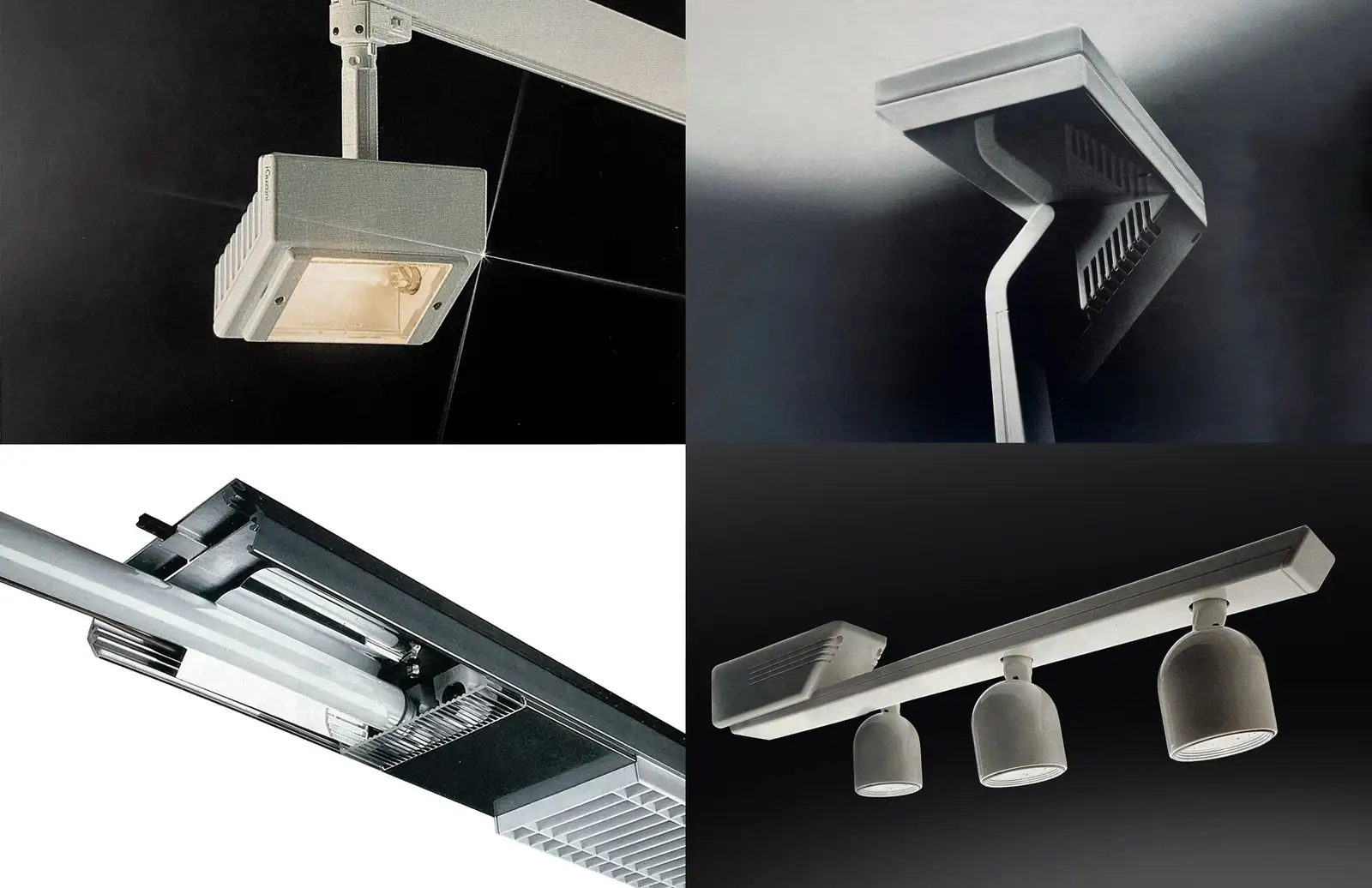
ADI Compasso d’Oro 1989
«For its contribution to resolving the many technical and formal requirements of a complete lighting system.»
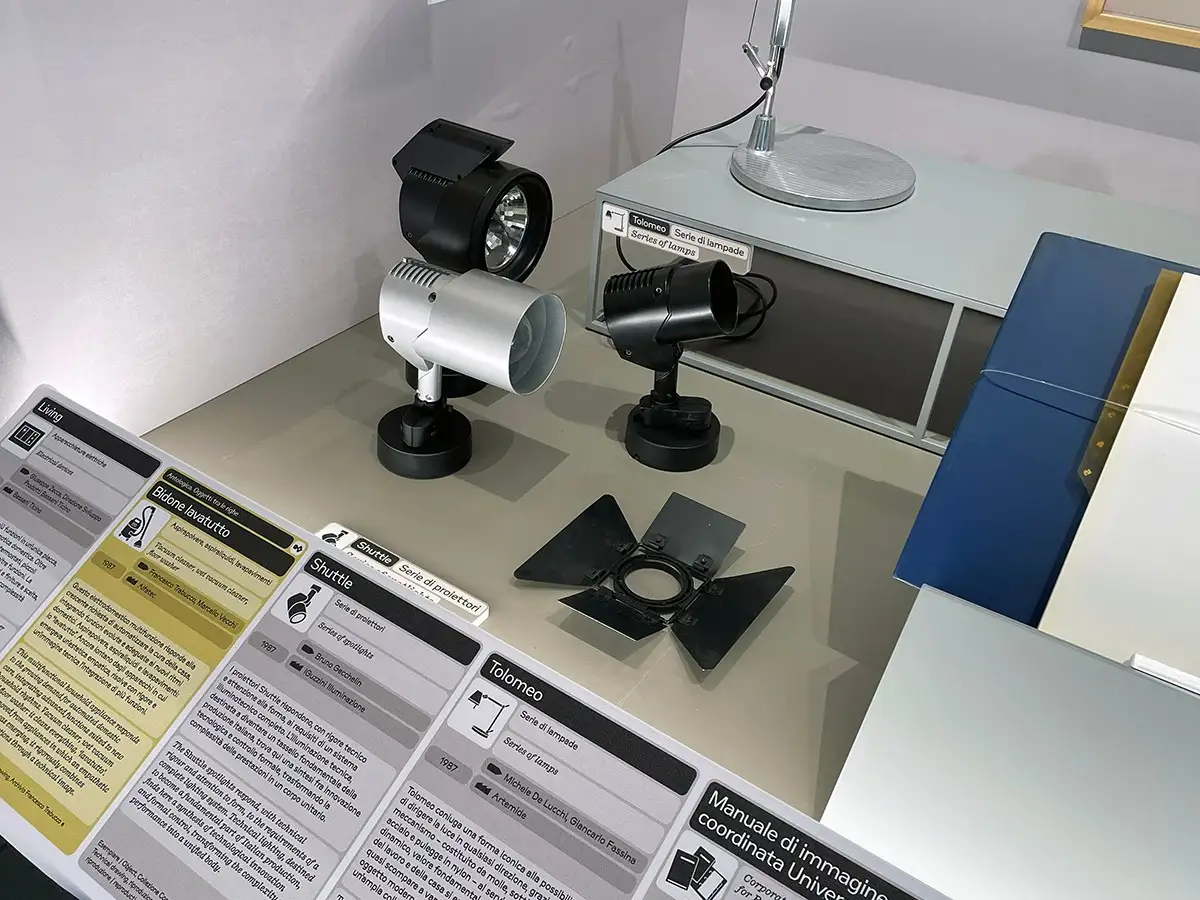
The catalogue kept growing for years, over more than twenty years of collaboration between the studio and the company. Shuttle is part of the collection of the ADI Design Museum – Compasso d’Oro in Milan, where three projectors of the family and a louvre accessory are on display.
What we learnt
The client had come with a wish and the doubt that it could not be done. What was missing was not a drawing: it was proof that a coordinated family was technically possible.